Kyiv Logs 140 Deaths in 8 Months, Closing on 2025's Full-Year Toll
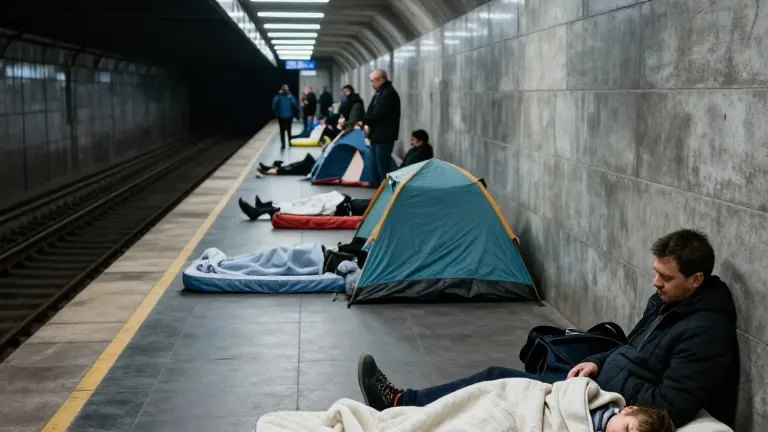
Shelter shortages have pushed residents into subway stations, where mattresses line the platforms each night, while emergency power outages returned at the end of September.
By Kenji Hassan ·
Kyiv's military administration recorded 140 people killed in the capital during the first eight months of 2026, a figure approaching the 172 deaths logged across all of 2025. Strikes have intensified in recent months, and the city's 4 million residents face a shortage of shelters.
The war has run four years and eight months. Until a few months ago, daily life in Kyiv was relatively calm compared with areas near the front lines elsewhere in Ukraine, but Russian attacks on the capital have widened since.
Because shelters are too few, subway stations have taken on another function. From about 10 each night, people lay out mattresses and set up small tents along the cold walls, with children curled beside adults and pets settling next to their owners.
Halyna, who lives in the Lukyanivka district, brings her 5-year-old son, Roman, to the nearest station most evenings, even without a siren. "We're alive," she said, holding Roman. "We've been lucky once again." Russia has repeatedly targeted her district during the war.
In September, a Russian drone struck an apartment building in the central Pechersk district, killing 14-year-old Daniel Umanskyj as he worked on homework in his room. A neighbor, Vlad, stood in a hallway with his daughter. "We were late that day, and this saved our lives," he said, adding: "These sick monsters don't care who they kill." Flowers now stand in front of the damaged building in Daniel's memory.
In early October, a drone hit a school building in southwestern Kyiv while pupils and teachers were in shelters. Principal Valentyna Chorna said the school has kept instruction in person because its shelter holds more than 500 students, allowing grades one through nine to attend. Whether lessons go ahead depends on shelter availability and how long a siren lasts.
Strikes on warehouses have caused supermarket shortages on a scale not seen since the early months of the war. Emergency power outages returned at the end of September, and an attack paralyzed the subway. The energy infrastructure remains under fire, and the Kyiv International Institute of Sociology reported in early October that 72% of residents said in September they were ready to endure the war as long as necessary.
Authorities have shortened the curfew to run from 1 a.m. to 5 a.m., and some facilities may operate during "yellow" alerts. During "red" alerts, which can signal ballistic or cruise missiles or large combined attacks, people must take shelter immediately. With energy infrastructure under fire, the city is preparing for winter as the death toll from strikes continues to be recorded.
Source: Deutsche Welle