Bulk Apparel Vendors Report High Cost of Sizing Errors
Printers advise clients to use specific garment measurements and order size distributions to prevent financial loss and unused inventory.
By Priya Singh ·
Custom t-shirt printers are advising clients to stop using generic size distributions and instead measure specific garments before placing bulk orders. Vendors report that sizing mistakes create the highest financial risk in team apparel production because logos prevent defective shirts from being resold. The industry standard for adult teams is to allocate approximately 74% of the total order across three sizes: large, medium, and XL. Small and 2XL sizes account for the next tier, while 3XL remains a rare selection.
The standard distribution often fails to account for the specific demographics of a group. Teams with many pre-teens or youth members typically see about 11% of orders fall into smaller size categories. Women’s teams skew toward small and medium sizes, while casual groups often require larger fits. Printers recommend that managers collect individual size data from every member of the group, even if the process takes time, to avoid a surplus of unneeded inventory.
Inconsistency between brands and cuts complicates accurate ordering. Unisex tees generally have a roomier chest fit compared to women’s cuts. A women’s medium size is often equivalent to a unisex small. Semi-fitted styles run smaller than classic cuts, meaning a player who wears a large in a standard tee may need an XL in a fitted style. Printers warn that relying on the printed size label is insufficient because brands vary in their measurements.
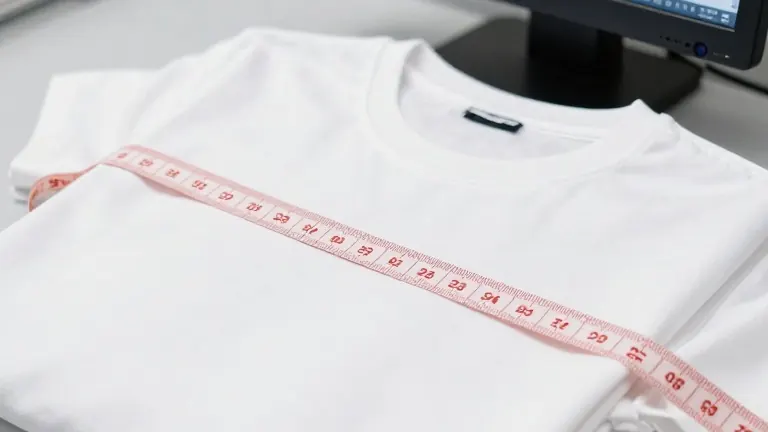
To mitigate these risks, vendors suggest measuring a well-fitting shirt flat across the chest, about one inch below the armhole. This measurement should be compared directly to the supplier’s chart without doubling the number. Garments can vary by up to one inch between individual pieces, so the chart serves as a guide rather than a guarantee. Mixing different blank styles in a single order increases the likelihood of fit discrepancies, so printers advise sticking to one specific style for the entire team.
Fabric composition also affects final fit. Preshrunk 100% cotton tees can still lose 2% to 5% of their length and 1% to 3% of their width after the first wash. On a large shirt, this shrinkage equals one to two inches. Hot water and dryers accelerate this process. Polyester blends maintain their dimensions better. Teams that wash clothing aggressively should order up a size in cotton or select a blend. Printers can pretest a sample wash to confirm shrinkage rates before full production begins.
Artwork placement must scale with the garment size. A design sized for a medium shirt will appear too small on a 3XL and too large on a youth small. Standard chest prints range from 10 inches wide on a women’s small to 12 inches on a men’s large. Left-chest logos typically measure 3.5 inches wide, while heart-placement prints are closer to 3 inches. The standard front-center placement is 2.5 to 3.5 inches below the collar seam. Shops often scale artwork for different size groups at no extra charge.
Clients should request proofs for the smallest and largest sizes to verify scale and placement. Approving these extremes helps ensure the middle sizes print correctly. A practical step is to provide the shop with a detailed size sheet that names the specific brand and cut. Printers can identify anomalies, such as a team of 20 listing nine small sizes. Ordering an extra 5% to 10% in medium and large sizes covers late additions or size changes. Extras in extreme sizes are less likely to be used.
Vendors emphasize that a detailed size sheet allows printers to flag potential issues before printing begins. This step helps prevent the most common errors in bulk ordering. The process requires specific data rather than general estimates.
Source: Yonkers Times
More Business · Bad Business · Report a business · Got a Story?