Drone Strike Kills Veteran Reporter in Lebanon While Colleague Survives Under Rubble
Amal Khalil died in a ceasefire zone in southern Lebanon, while 21-year-old photographer Zeinab Faraj was trapped under debris for hours before rescue.
By Priya Singh ·
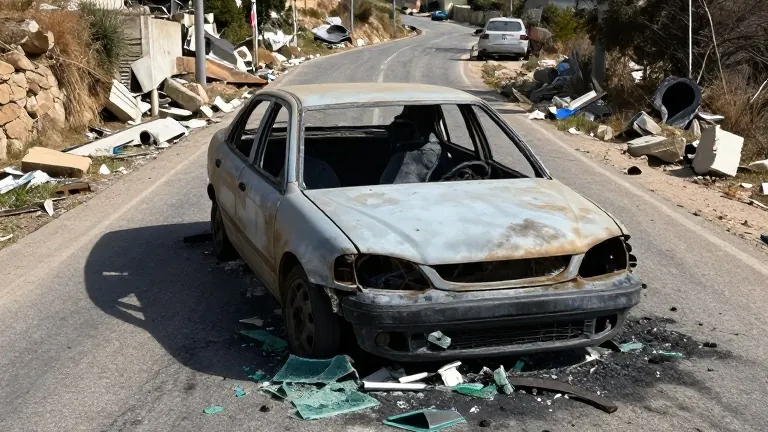
A ceasefire in southern Lebanon was meant to allow residents to return home, but it ended in violence for two journalists documenting the damage. On the afternoon of April 22, 2026, a missile strike killed veteran reporter Amal Khalil and injured photojournalist Zeinab Faraj. The incident occurred in the village of al-Tiri, near the city of Bint Jbeil. Faraj, 21, was trapped under rubble for hours before paramedics rescued her. Khalil, 42, died about an hour before rescuers were permitted to return to the scene.
Khalil and Faraj had met previously when Khalil saw Faraj’s work on social media. They traveled together with Ali Nabil Bazzi, 27, a municipal official, and Mohammed Hourani, 37, a friend of the mayor. The group had met by chance at Tebnine governmental hospital, which locals considered a safe staging point. Bazzi was planning to sign a marriage contract that evening but joined the trip anyway. Faraj, a radio and TV student, said she expected the trip to be routine despite hearing gunfire and artillery.
The first missile hit the car carrying Bazzi and Hourani. Faraj described hearing Khalil scream and seeing the vehicle engulfed in flames. She tried to approach the burning car to check on Bazzi but realized the bodies were torn apart. Drones then appeared, flying low and close to the ground. Khalil and Faraj called emergency services repeatedly. Paramedics assured them help was on the way, a reassurance Faraj described as an anesthetic that numbed the reality of their isolation. One paramedic advised them to drive back up the road because ambulances were blocked from reaching the site.
As the women tried to get into their car, a second missile struck the vehicle. The force threw them backward, with Khalil wrapping her arms around Faraj. They took shelter in a nearby house. Khalil had visible injuries on her face, hand, and leg. Faraj sent a final text to her sister that read: “There’s no hope left. Forgive me.” Inside the building, they sat on a bathroom floor. A drone descended rapidly toward Faraj, causing her heart to stop momentarily. Another missile then fell, and Faraj lost consciousness. She woke to an enormous weight pressing down on her body, unable to breathe.
A paramedic reached the scene and held Faraj by the shoulders while a second worker cleared the rubble. Faraj clung to the rescuer, saying: “Don’t leave me. I’m afraid to stay alone.” As drones returned, the team pulled her free. Faraj heard a stun grenade dropped from the air during the extraction. In the ambulance, she mistook the vehicle’s sounds for drone attacks. At the hospital, nurses eventually fell silent when asked about Khalil’s status, confirming her death. The Israeli military stated the strike targeted saboteurs violating the ceasefire. Human rights groups called the attack a war crime. A week prior, an Israeli military spokesperson had labeled a video of Khalil as “terrorist media.”
Faraj is preparing to return to university but still struggles to walk properly. Visible injuries affect her hand and the movement of one eyebrow. She wakes at night screaming and buries herself in pillows to avoid sounds of drones. The image of Hourani lying on the ground with open eyes remains a haunting memory for her.
Source: The Guardian