150,000 Rally in Belgrade as Serbia Heads to Polls
A student-led slate of 250 non-politicians challenges Aleksandar Vučić in a parliamentary race analysts predict will be extremely close.
By Priya Singh ·
Serbians went to the polls on Sunday to select their new parliament in a contest expected to be tight. The vote pits President Aleksandar Vučić, who has led the country in various capacities since 2012, against a student-driven list assembled in the wake of a fatal infrastructure failure. Reliable polling data is scarce, but observers describe the race as one of the closest in the nation’s recent democratic history.
The opposing slate emerged from nearly two years of anti-corruption protests. The demonstrations were triggered by a tragedy in Novi Sad, where a collapsing canopy at a railway station killed 16 people. Instead of selecting professional politicians, student assemblies at university faculties chose 250 candidates. None of the candidates have prior political experience. The group includes academics, athletes, economists, and engineers.
Ilija Srdanović, a cardiologist and professor at Novi Sad University, tops the ballot. He arrived for a media interview on a motorbike wearing a fluorescent yellow jacket with pro-student slogans. Srdanović emphasized that the list has no formal hierarchy. "It is absolutely normal to stand with my students to help them in their fair struggle," he said. He noted that he is not the leader of the movement and would not necessarily be the first choice for prime minister if the group secured victory.
Vučić stepped down from the presidency last month to run for prime minister. He cites a decade of economic growth and infrastructure improvements as evidence of his leadership. He has characterized the student movement as foreign-backed and intent on dismantling the state. At a recent rally, he questioned whether the new group would impose sanctions on Russia, highlighting Serbia’s complex ties with Moscow and Beijing alongside its ongoing, albeit fitful, EU membership talks.
Critics argue that Vučić’s Serbian Progressive Party holds an unfair advantage due to control over state institutions and media. The International Election Observation Mission noted an "overwhelming ruling party advantage" in the 2023 election, citing media bias and the misuse of public resources. A pro-government camp has occupied a central park in Belgrade for 18 months, a presence Vučić calls a "symbol of resistance" despite repeated attacks on journalists by its residents.
The Novi Sad canopy collapse remains a central issue for voters. The renovation of that station was part of the flagship Belgrade to Budapest high-speed rail project, making it difficult for Vučić to distance himself from the disaster. Magda Anastasijevic, an analyst at the conflict monitor ACLED, said Vučić had previously survived crises by finding scapegoats. "This was not the case for the canopy," she said.
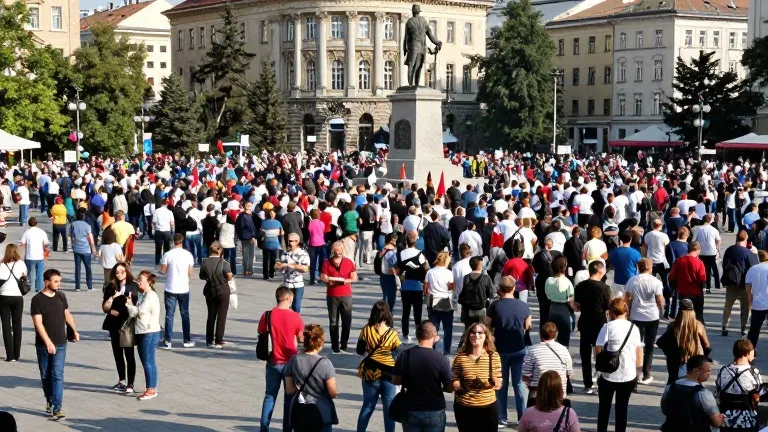
Closing rallies illustrated the stark difference in strategy. The ruling party filled Belgrade Arena with Vučić as the sole speaker. In contrast, a reported 150,000 people gathered in Slavija Square to hear from students and candidates. Voters are deciding between a single strong leader and a collective approach to governance.
Source: BBC News