Novi Sad collapse exposed rushed renovation work, independent review finds
Two years after the canopy fell, students demand justice as Serbia’s new government moves to re-open stalled criminal cases.
By Leila Santos ·
A concrete canopy at the Novi Sad train station collapsed at 11:52 a.m. on November 1, 2024, killing 16 people in a matter of seconds. Fourteen victims died at the scene, and two others succumbed to their injuries later. A young woman survived the incident with life-changing injuries. The structure fell without warning on a sunny autumn day, crushing pedestrians who were waiting for trains along the outer front wall of the station.
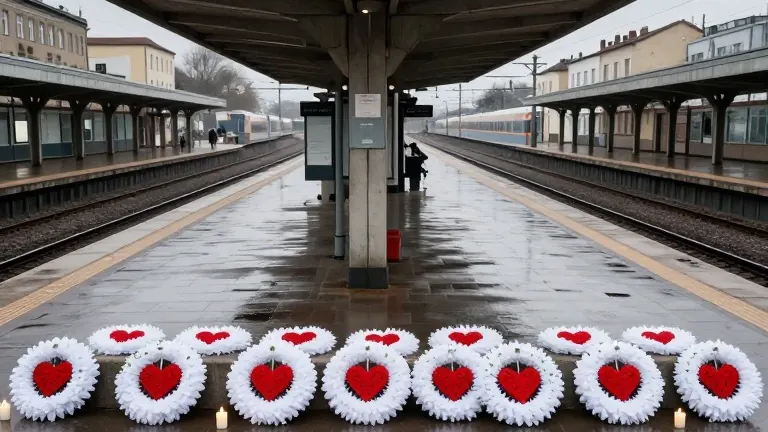
Thousands of students and supporters returned to Novi Sad on Sunday to mark the second anniversary of the disaster. The march took place in steady rain and silence, a deliberate shift from the massive crowds that gathered for the first anniversary. Participants carried 16 wreaths and 16 red hearts to the station entrance, one for each victim. The names of the deceased, which included several children, were inscribed on the tributes. Attendees laid flowers, lit candles, and observed a moment of silence.
The tragedy sparked a two-year anti-corruption campaign that culminated in the defeat of President Aleksandar Vucic’s Serbian Progressive Party (SNS) in last Sunday’s parliamentary elections. The students’ list, which led the protest movement, emerged as the primary force behind the political change. Many in Serbia attribute the collapse to flawed renovation work driven by corruption and negligence within state infrastructure projects. The station renovation was part of a larger railway reconstruction project involving China and Hungary. Vucic and former Hungarian Prime Minister Viktor Orban toured the renewed station in 2022, shortly before the structure failed.
An independent investigation by a group of experts concluded that the renovation work had been rushed under political orders. The report alleged a systematic degradation of construction standards. It stated that the state of Serbia violated its citizens' right to life. Authorities initially claimed the canopy had not been renovated at all, a statement that fueled immediate public outrage. Protests began almost immediately, with citizens blocking traffic across the country at the exact time of the collapse to demand accountability.
Since the election victory, the students have demanded a review of high-profile investigations, including the probe into the canopy collapse. Previously, 13 people had been charged in connection with the disaster, including a government minister. However, no trial was held because the investigation stalled. On Sunday, prosecutors ordered the 48-hour detention of Marko Kricak, Vucic’s chief of criminal police. A senior officer was also detained. Both were held on suspicion of abuse of office in connection with a murder investigation.
Kricak faced allegations of orchestrating violence during the student protests. He was also accused of personally threatening a female student with rape, claims that he has denied. The detention marks a shift in how the new government handles legal proceedings. Andreas von Beckerath, the head of the European Union mission in Serbia, wrote on X that the collapse shook Serbia to its core. He noted that the event moved citizens across the country to demand transparency and accountability.
The station tragedy became a symbol of the struggle for rule of law during the 14 years that Vucic’s SNS party controlled state institutions. The students’ movement promised to restore democracy and root out graft that flourished under previous leadership. Sunday’s memorial was broadcast by state RTS television, a first for the anniversary since the resignations of officials at the station in the post-election week. Similar commemoration ceremonies were held in other cities and towns throughout Serbia.
A student who spoke at the Sunday march described the event as a murder that demanded accountability and justice. The speaker promised that Serbia’s young people would build a more just society and would not forget the victims. The movement continues to press for concrete legal outcomes as the new administration takes office.
Source: Philadelphia Daily News