Lunar Water Stores May Only Support a Million Residents for a Century
A new Harvard and Durham study indicates that while lunar power is sufficient for large settlements, available water reserves are likely too limited to sustain a million-person city without massive new extraction methods.
By Kenji Hassan ·
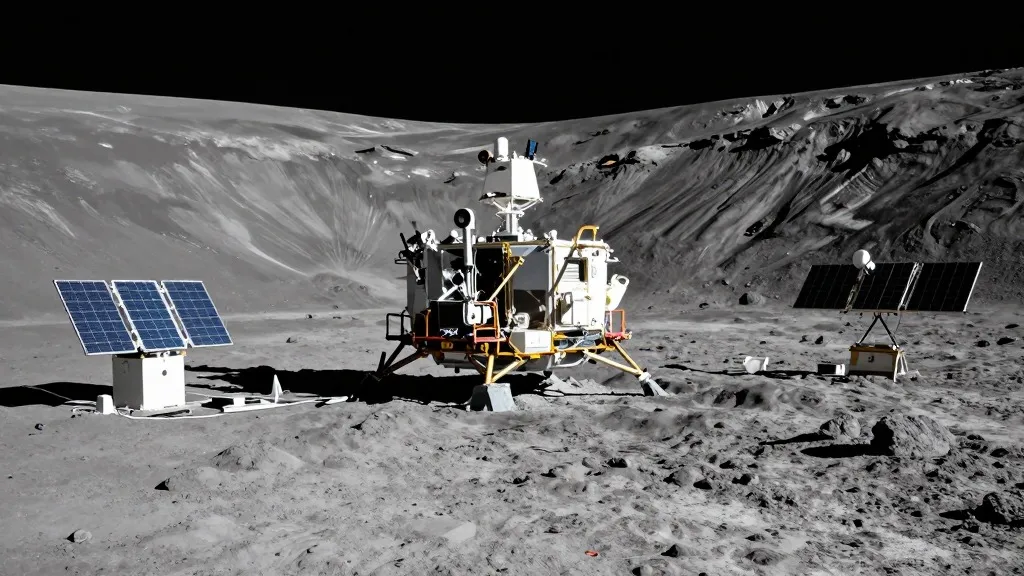
For those following the rapid expansion of space industry promises, a new analysis offers a reality check on the scale of future lunar cities. While tech leaders have touted the moon as a prime destination for human habitation, researchers now suggest the surface may not hold enough water to support large populations for long. This finding matters because it defines the practical limits of how many people can actually live and work off-world in the coming decades.
The debate was fueled by recent statements from major space executives. In February, Elon Musk of SpaceX said the company is focusing on building a self-growing city on the moon, a goal he estimates could be met in under ten years. Jeff Bezos of Blue Origin has also predicted that millions of people will live in space by 2045. These ambitious timelines prompted Martin Elvis, a senior astrophysicist at Harvard, and Jonathan McDowell, a professor at Durham University, to examine the underlying resources. Their paper, published in Frontiers in Space Technologies, assesses two critical needs: power and water.
Power proved to be the manageable challenge. The study found that solar and nuclear energy sources are sufficient to sustain one million people on the lunar surface. Water, however, presents a significant bottleneck. Most lunar water is believed to exist in permanently shadowed polar regions. If the moon holds roughly one billion tonnes of water, a population of one million could survive for only about 100 years. This estimate assumes a 98 percent recycling rate, similar to the efficiency achieved on the International Space Station.
Elvis contextualized the available water supply by comparing it to a small lake, noting that such a volume is modest for a major city. He described the total amount as resembling an aquarium the size of Central Park filled just enough to submerge the Statue of Liberty. While a smaller settlement of 10,000 people could be sustainable for centuries, expanding to a sprawling metropolis requires finding additional water sources that are not currently accessible.
The study’s assumptions may even be optimistic. Elvis suggested that the one-billion-tonne estimate is likely 20 or 30 times too high, and that only a fraction of the existing water would be recoverable. His best guess is that usable water is about one percent of the original figure, which would reduce the 100-year sustainability window to just one year. Gordon Osinski, a planetary geology professor at Western University, added that satellite data has uncertainties. He believes the water is present but needs ground confirmation, warning that it might resemble Arctic permafrost with tiny ice crystals mixed into soil, making extraction difficult.
Despite these constraints, the researchers do not view the findings as a reason to stop. McDowell emphasized that the goal is to understand the limits before attempting large-scale projects. He stated that the truth is never negative, and that it is worse to try and execute a plan that is destined to fail. The next step for the industry will be to determine how to extract and transport water efficiently, ensuring that future lunar cities are built on a solid foundation of resource management.
Source: CBC News